
You know their birthday is coming. You care about them. Still, every idea feels too generic, too risky, or too close to something they already own.
This guide will help you choose a gift they’ll genuinely appreciate, even when they haven’t shared a wish list and seem to have everything.
The answer isn’t more product browsing. It’s paying attention in a more useful order.
The problem isn’t a lack of gift ideas
A search can give you hundreds of gift ideas in seconds. It can’t tell you which one belongs to this person.
A thoughtful gift is evidence of attention. It says, “I listened, I remembered, and I’m here.”
That changes the goal. You’re not trying to prove how creative, generous, or up to date you are. You’re trying to make someone feel recognized.
Personalized isn’t the same as customized
A customized gift changes the object. It adds a name, date, photo, color, or message.
A personalized gift changes the choice. It’s selected because of the person’s habits, values, current life, or your shared history.
A monogrammed tumbler can still be the wrong gift if they never carry a tumbler. A plain ticket can feel deeply personal when it’s for the small band they mentioned months ago.
Start with the person. Add customization only when it strengthens the meaning.
Use the five-question gift discovery method
Set a five-minute timer. Close the shopping tabs and write one honest line for each question below.
1. What do you remember?
Think about what they’ve mentioned more than once. It could be a plan, a frustration, a favorite story, a saved post, or something they keep meaning to do.
Don’t turn the clue into a product yet. “She misses painting” is more useful than “buy art supplies” because it leaves room for an art class, a studio visit, a sketchbook, or time to paint together.
2. What do they gravitate toward?
Notice what they choose without being prompted. What do they order, wear, rewatch, collect, photograph, talk about, or make time for?
Repeated behavior is often more useful than a one-time comment. Their weekly ritual of trying local bakeries or cafes may tell you more than a vague plan to travel someday.
3. What matters to them right now?
The right gift fits the chapter they’re living in, not the version of them you remember from five years ago.
Have they moved, changed jobs, become a parent, taken up a hobby, or decided to simplify? A gift that supports the present moment feels more thoughtful than one based on an old identity.
4. What would surprise them?
A good surprise feels unexpected but recognizable. Their reaction should be, “You noticed that,” not, “Why did you buy this?”
Look for a detail they didn’t think anyone remembered. It might be a childhood snack, an author they loved, a place they want to revisit, or a small daily inconvenience they’ve learned to tolerate.
For instance, I once told my coworker that I loved distinctive bags that no one else had, so she gifted me with a completely handcrafted knitted bag! She also gave me an item of clothing since she knew I would like it and remembered me praising her while wearing it. These small gestures surprised me and I loved the fact that she cared to note every small thing that I mentioned or liked.
5. What could they love?
Now turn your clues into two or three gift directions. Don’t choose a specific item yet.
For example, “slow Sunday mornings,” “just moved,” and “loves local coffee” could become a home ritual, a neighborhood discovery, or a shared breakfast. That’s stronger than searching for “unique gifts for a 34-year-old.”
Turn clues into a gift direction
Use this table when your notes still feel scattered.
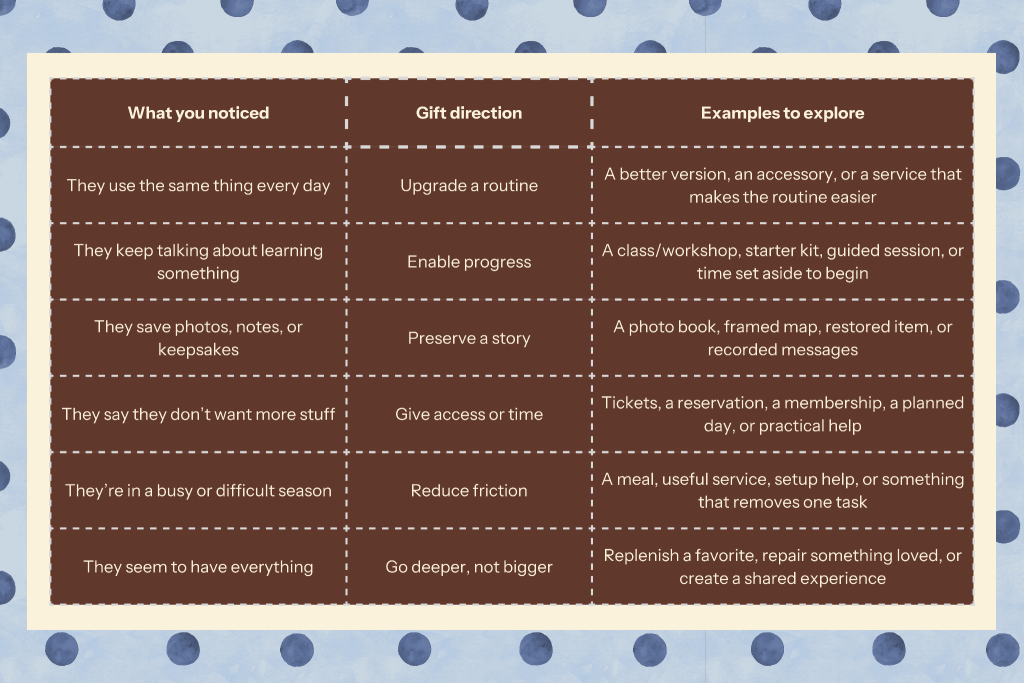
| What you noticed | Gift direction | Examples to explore |
| They use the same thing every day | Upgrade a routine | A better version, an accessory, or a service that makes the routine easier |
| They keep talking about learning something | Enable progress | A class/workshop, starter kit, guided session, or time set aside to begin |
| They save photos, notes, or keepsakes | Preserve a story | A photo book, framed map, restored item, or recorded messages |
| They say they don’t want more stuff | Give access or time | Tickets, a reservation, a membership, a planned day, or practical help |
| They’re in a busy or difficult season | Reduce friction | A meal, useful service, setup help, or something that removes one task |
| They seem to have everything | Go deeper, not bigger | Replenish a favorite, repair something loved, or create a shared experience |
Most thoughtful gifts aren’t rare. They’re specific.
How to choose birthday gifts when you don’t know them well
When you have limited information, let the relationship set the boundaries. Thoughtful shouldn’t become overly intimate.
For a new coworker, choose something tied to a known routine or shared workplace moment. Avoid intimate categories or anything that creates pressure to reciprocate.
For a newer friend or distant relative, build from one shared interest. A small experience, useful item, book, or local treat can feel personal without pretending you know everything about them.
For a child or teen, ask a parent about their current interests, household rules, and what they already own. “What are they into this month?” is usually a better question than “What do kids that age like?”
Choose your budget before you browse. A clear range keeps you focused on fit rather than price.
Planning the birthday as well? You can set the tone with Airawath’s free digital invitation templates, then use the same person-first clues to shape the gift and the celebration.
What do you give someone who has everything?
Someone who has everything usually has enough objects. They haven’t necessarily had every experience or made time for everything they value.
Try one of these directions:
- Replace: Upgrade a worn item they use and love.
- Replenish: Restock a favorite food, coffee, tea, art material, or other consumable.
- Give access: Arrange tickets, a class, a reservation, or a membership.
- Complete: Help finish a photo album, home project, collection, or plan they’ve delayed.
- Preserve: Repair an heirloom, digitize old media, or protect a meaningful memory.
- Give time: Take a task off their plate or plan time together with the details handled.
Avoid gifts that create storage, maintenance, or another obligation. Generous shouldn’t mean burdensome.
The best gifts for someone who has everything aren’t necessarily unusual. They fit so well that they couldn’t have been chosen for just anyone.
Run the four-part reality check before buying
Before you check out, ask:
- Will they use, enjoy, or remember this—or only compliment it politely?
- Does it fit their life now?
- Will it create extra work, clutter, cost, or obligation?
- Can I explain, in one sentence, why it made me think of them?
Three strong “yes” answers are a good sign. If the gift’s only advantage is that it looks impressive, pause.
For an experience, check dates, location, accessibility, transferability, and any extra cost to the recipient.
Make a simple gift feel more personal
Meaning often sits in the context around the gift.
Add a short note that names the clue. Instead of “Thought you’d like this,” write, “You said you wanted to draw again after work, so I picked something that makes it easy to start without setting up a whole studio.”
Handle one setup step when appropriate: book the table, print the photo, charge the device, or include the first ingredient. Choose timing that suits them, not the audience.
You don’t need to put their name on everything. The reason behind the choice is often the most meaningful form of personalization.
For example if you would be gifting them a Tshirt, you could write something like ‘ This is how comfy you make me feel!’. If it’s a coffee mug, you could write, ‘Something for your daily dose of comfort’.
Try the five-minute Know Them Better Gift Discovery Workbook
Still drawing a blank? Use the Know Them Better Gift Discovery Workbook to turn what you already know into clear, personalized gift directions.
The interactive quiz asks five quick questions:
- What do you remember?
- What do they gravitate toward?
- What matters to them?
- What would surprise them?
- What could they love?
At the end, you’ll have practical directions to search, compare, or take to a gift assistant.
CTA button: Reveal My Gift Directions
Still stuck? Brief a thoughtful assistant, not a search bar
Once you have a few clues, use Talk To Elie with the occasion, your relationship, budget, age range, hobbies, preferences, and any must-haves or must-avoids.
Instead of typing “gift for Mom,” try this:
My mom turns 62. She spends most mornings in her garden, has been trying to organize old family recipes, dislikes clutter, and rarely buys anything for herself. My budget is $60–$100. I want the gift to feel caring, not medical or overly sentimental.
A good brief doesn’t replace thoughtfulness. It translates your observations into options.
The gift doesn’t have to be perfect
“Perfect” creates pressure. A well-matched gift with a clear reason behind it often feels more personal than an expensive showpiece.
When you’re stuck, return to one question: What would make this person feel seen in the life they’re living now?
That’s where thoughtful gifts begin.Also, it need not necessarily be one perfect gift. It’s always nice to create an experience that the person won’t forget. Adding a couple of things bought and handmade together is the best way to put together a gift that will be cherished.
Frequently asked questions
How do I choose a gift when someone says they don’t want anything?
Take them seriously. Consider a consumable, shared experience, practical help, charitable gift, or heartfelt note rather than adding another object to their home.
You can also ask a low-pressure question: “Would you enjoy something we can do together, something useful, or genuinely no gift this year?”
How do I find personalized gift ideas with very little information?
Start with the occasion, relationship, current life stage, and one known routine or interest. Keep the gift low-risk, and ask a mutual friend or family member when the category could be personal.
What is a thoughtful gift for someone who has everything?
Choose something that gives time, access, progress, replenishment, preservation, or connection. The goal is not to add more; it’s to support something they already value.
Is it okay to ask someone what they want?
Yes. Asking can be considerate, especially when preferences, sizing, accessibility, or waste are concerns.
Keep some surprise by offering categories instead of asking for a specific product: “Would you prefer an experience, something for home, or something connected to your hobby?”